

Animal protection protects all living beings
Only a holistic ecosystem is resilient
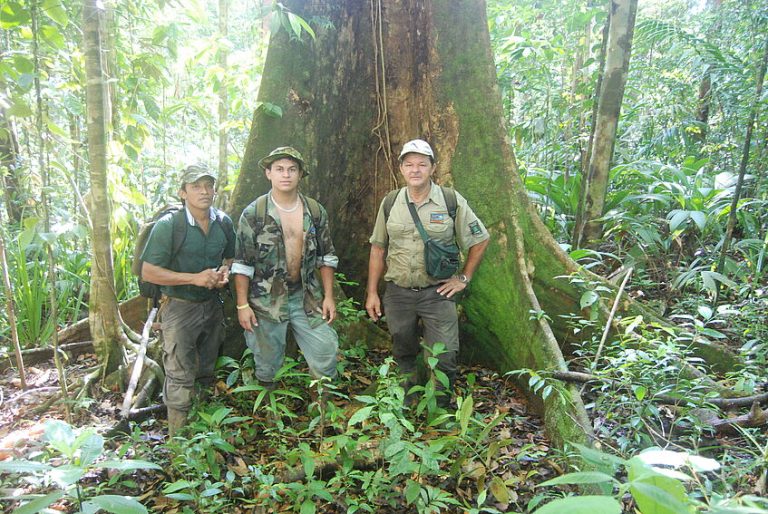
The Esquinas Rainforest was officially designated as Piedras Blancas National Park in 1991. Despite this, poaching and illegal logging continue to occur, which is why the Rainforest of the Austrians association supports the deployment of park rangers. Since June 2003, we have been funding park rangers (“Guardaparques”) in Piedras Blancas National Park. Currently, two park rangers and one administrative staff member are funded at the national park stations in La Gamba and Río Bonito.
The main task of the “Guardaparques” is to combat illegal activities in the rainforest such as hunting, logging, coastal fishing, river pollution, gold panning, or the intrusion of illegal settlers into the rainforest. In addition, the rangers are responsible for maintaining trails, buildings, and park boundaries, as well as managing camera traps. Their work is crucial for protecting this valuable ecosystem.
The monthly gross salary of a park ranger for the year is €1,524 (CRC 861,190). The salary for an administrative staff member is €1,310 (CRC 740,379), including administration by Fundación Corcovado, allowances, social insurance, health insurance, and accident insurance. In total, we need €52,300 per year for 2 park rangers and 1 administrative staff member. We urgently need your help to ensure rainforest protection.
We have shared a long-standing friendship and collaboration with the Corcovado Foundation since 2003. This environmental organization is committed to projects on the Osa Peninsula and is responsible for employing our park rangers as well as constructing the ranger station in La Gamba.
A successful project to protect sea turtles on the Pacific beaches of the Osa Peninsula and in the central Pacific has saved the lives of countless turtles. Turtles are tagged, biometric data is collected, and egg-laying and nests are monitored by volunteers. The newly hatched baby turtles are gently released into the ocean and returned to the wild.
Our current efforts focus on the Punta Mala – Playa Hermosa Wildlife Reserve in the central Pacific. There we aim to restore a healthy population of sea turtles and support this project financially through the sale of species conservation certificates.
More information: http://www.corcovadofoundation.org/sea-turtle-conservation/
From 2010 to 2014, we supported the work of the Yaguará organization with a total of USD 53,000. Their goal was to secure the population of wild cats in southern Costa Rica (Osa Peninsula, Rainforest of the Austrians) through targeted measures. With our donations, camera traps and radio collars were purchased, compensation was paid to farmers, and educational work in schools and communities was supported.
We have decided to support the wildcat program of Osa Conservation (http://osaconservation.org/category/wildcats/) and acquire camera traps to be set up in the vicinity of the Esquinas Rainforest Lodge and the Tropical Station La Gamba. The advantage is that the data can be analyzed by our staff on site. We hope to continuously publish interesting and informative photos of the mammals of the Austrian rainforest.
The foundation “Fundación para la Restauración de la Naturaleza,” operated by the private zoo Zoo Ave near San José, started a breeding program for Scarlet Macaws in 1996. The goal was to reintroduce these nearly extinct parrots to their natural habitat. Piedras Blancas National Park (Rainforest of the Austrians) was selected as the most suitable location for releasing the macaws after an intensive search. The association donated a 13-hectare property near Playa San Josecito on the Golfo Dulce to the foundation. At the end of 1998, five aviaries, a field kitchen, and two simple prefabricated houses for the biologists were built there.
The first macaws were soon brought there, where they learned to fly in the aviaries and regained their flight abilities. Their diet was gradually switched to wild fruits from the surrounding area, and their social behavior was observed daily by zoologists. Each year, the population was expanded by 10 to 15 macaws.
In November 2008, the hundredth macaw was released. The project exceeded all expectations. Originally, the survival rate of the released birds was estimated at 50 percent, but more than 80 percent of the macaws have survived in the wild and some have already produced offspring. The macaws leave their roosting sites at sunrise, spend the day in the Almendro trees along the coast, and return only at sunset. The birds fly as far as Río Esquinas in the north and to Golfito in the south—a distance of 20 kilometers. The park rangers of the national park administration regularly bring confiscated parakeets and parrots to the release station.
Between 1998 and 2000, an ocelot and several margays (tree ocelots) were released by the wildcat organization Pro Felis. Confiscated capuchin monkeys, coatis, raccoons, caimans, and turtles also found a new home in the Rainforest of the Austrians. The Rainforest of the Austrians supported the release projects from 1998 to 2008 with more than USD 50,000.